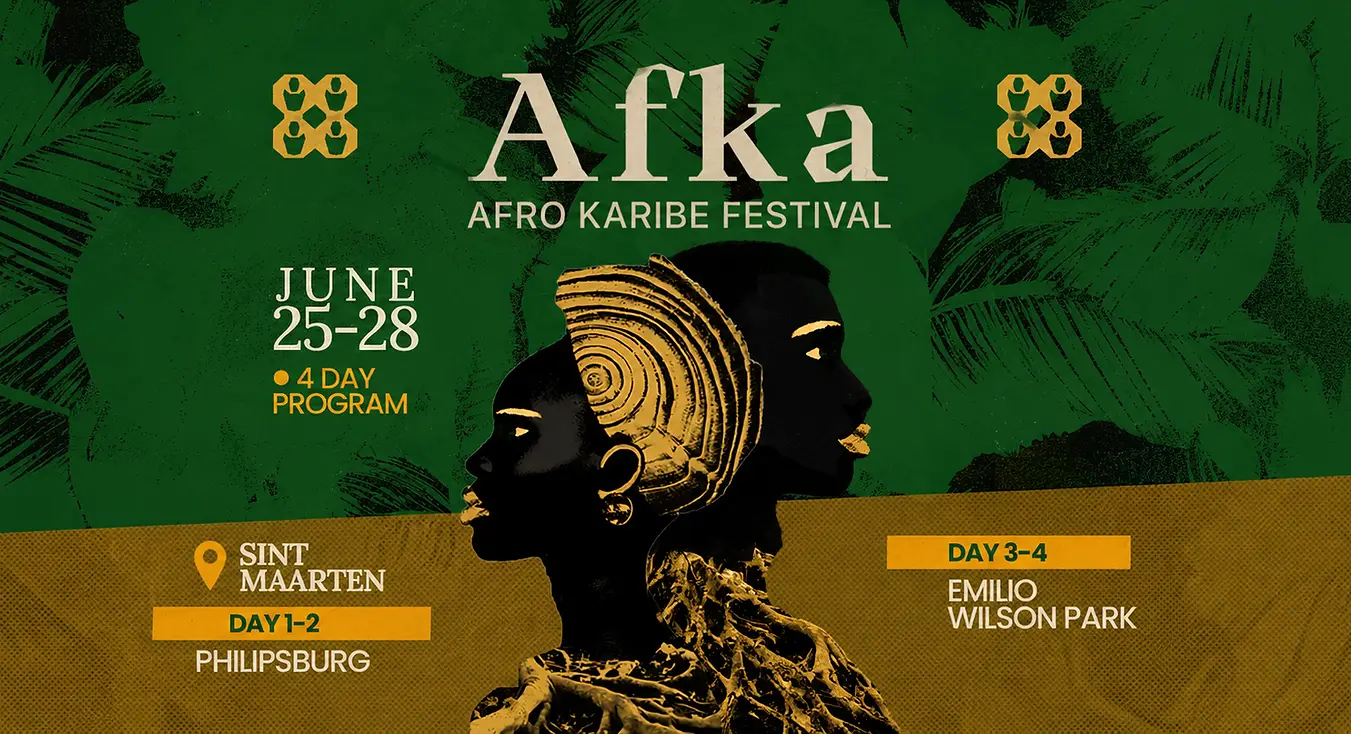
Sometimes it takes a celebration to remind you who you are.
By Borney . July 2, 2026
The AFKA Festival was a prime example of taking responsibility to learn.
Culture is what we have been through, what we have seen, the stories that we were told, that transformed into the songs that we sang, which themselves were frozen in time by the paintings we drew. Culture is what we share, in order to never forget where we came from, and the AFKA Festival provided us with an abundance of it.
AFKA, the abbreviation of Afro Karibe, was a festival filled with art, knowledge, and history. The festival itself spanned four days.
Yes, four days, that’s almost as long as a full work week. I could not grasp why it had to be so long, but after attending the entire event, I understood.
One cannot rush culture.
The first night was the calm before the storm, a more intimate evening, with invited guests and a showcase of different art, sculptures, and paintings. It was an opportunity to meet the artists and learn what drew them to create. A few admitted that they created a piece specifically for the event, while others explained that they already had work that portrayed the event perfectly. Slavery, oppression, emancipation, and freedom were all pillars of their art.
This was not a closed event; people from around the world were welcome to showcase their interpretation of our history. Alongside local artists like Ruby Bute, Nica Iabelle, Percy Rankin, and Ras Mosera, there were also artists from Curaçao, such as Keer De la Nooi and Izaline Caslister, even Anna Sophie Drosd, all the way from Germany.
Art and history were what the AFKA Festival was all about, and from day one, they delivered just that.
The second day of the event was impossible to miss, even if you weren’t there, the unusual amount of traffic after 6pm would have left you wondering what was going on along Front Street. From the courthouse all the way down to the casino, traffic was at a standstill; no entry unless you were on the two legs the Lord has given you.
Three main locations were highlighted for the event: the historic landmark that is the courthouse, the beautiful tourism building, and the arcade. That evening the streets were filled with poetry, with the sound of drums, with people dancing. Performances happened at every corner, and most importantly, open conversation, ideas, and interpretations soared through the air.
Nelly Blais, an award-winning author, said his favorite thing about the AFKA Festival was: “The discussions [the at AFKA Festival] feel like a safe place, … all for positive goals.” I couldn’t agree more. I was originally invited to attend the first event expecting nothing, I was just there to accompany a good friend. I did not expect to be introduced to a new facet of my own island.
Overshadowed by our food, our wonderful beaches, and the bouyon blasting from the speakers of a passing car, our culture is easy to miss, but if you dig just a little deeper, you will find it.Our culture is so rich, and yet it barely gets to see the light.
I grew up on bedtime stories of One Tété Lohkey, a hero, a rebel, an unstoppable force. A story that taught me that achieving the life I want won’t come easy, but it isn’t impossible either.
I spent two years back home, and the first time I was able to truly reconnect with the story that shaped my childhood was at the AFKA Festival, thanks to a painting by Ruby Bute, on display at
the Axum Art Café. As soon as I saw it, I knew I needed it. I had never wanted a piece of art so
badly.
It was absolutely stunning.
That was not the only thing that moved me. The following day, at the Emilio Wilson Park, there were workshops on how to braid 4C hair, the history of head wraps, drum demonstrations, but
perhaps the most important workshop to me was the one on the Ponum dance.
For the past 26 years of my life, I believed I had heard all the stories. I had learned all the texts given to me by my history teachers; I thought I knew it all. But the Ponum dance is not something they teach in school, or something easily found in textbooks.
During her workshop, Clara Reyes said something that annoyed me. She said, “We have a responsibility to learn …” I immediately became defensive, I strongly believe the generation before
us has the responsibility to teach. How could we learn if we were never taught? She then continued: “… we have to be attentive and alert to find the information.” I am a stubborn one, and I stayed
annoyed, convinced that once again an older person was trying to shift all the responsibility onto the next generation. Because how on earth do you just find information? Where do you even begin to
look for something when you don’t know what you’re looking for?
Well, with little to no effort, Miss Clara Reyes showed me exactly how ignorant, lazy, and privileged I truly was, and all she did was show me a video. A documentary, to be exact, one that
took her many years to finish, so long that some of the participants were not able to see the end.
All it took was one conversation, one sentence, one word:
PONUM.
If you are not attentive, alert, or even just a little curious, the word Ponum would remain just a word an elderly person once said, long ago on a Thursday afternoon. Miss Clara Reyes showed interest in
a word, asked questions, got answers, asked more questions, and got the names of people who “would know more about that than me.” She kept asking, and kept getting more answers. She
searched for those answers for years, all around our island, wrapped them up in a bow, and served them to us. She took on the responsibility to learn, and all we were left to do was be attentive. With the knowledge I’ve gained, I now feel the responsibility to carry and share it.
The Ponum is a dance of emancipation. It was danced to celebrate freedom, and to express the sheer happiness of being alive and witnessing the shackles being removed. The Ponum dance is full of energy and expression, something we may not be able to fully reproduce as we are today, but it is the only way we have to dance in the footsteps of our ancestors.
I fear there are no right words to express how necessary the AFKA Festival is. I must admit I was extremely lucky to experience it personally. The things I learned would have taken me years to find
in a textbook. The AFKA Festival brought all of our culture together in one location so we could learn from it and experience it. For its very first annual event, it was wonderfully executed, from the amazing volunteers, to the incredible and welcoming staff, to the entertainment, to the activities for children. That it was only a handful of people, and they were still able to pull off something of that magnitude, leaves me with nothing but respect for them.
“We have a responsibility to learn … we have to be attentive and alert to find the information.” – Clara Reyes
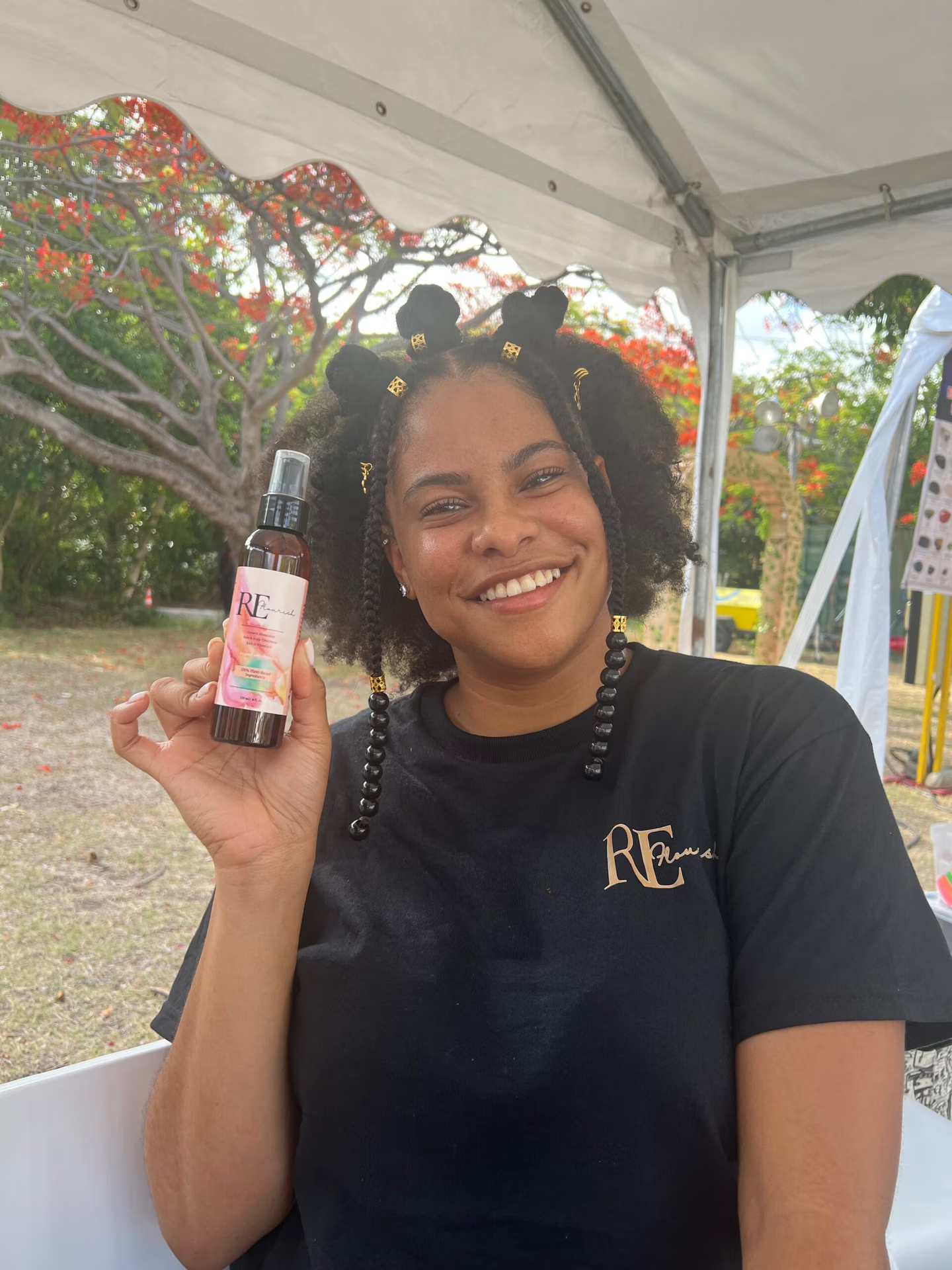
Re – Flourish | the face behind the brand
From hating her natural hair to building a business rooted in love and growth, one woman’s journey back to herself.
The Hillside: Eco-Retreat
Saint Martin has a new kind of escape — and it’s not a hotel. Glamping, hiking trails, workshops, and venue rentals, all in one place. I’m spending three days there to bring you the full story. Here’s what’s coming.